




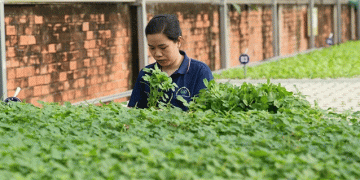


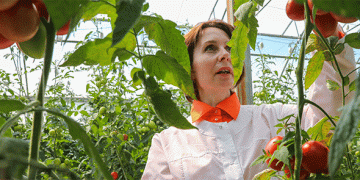
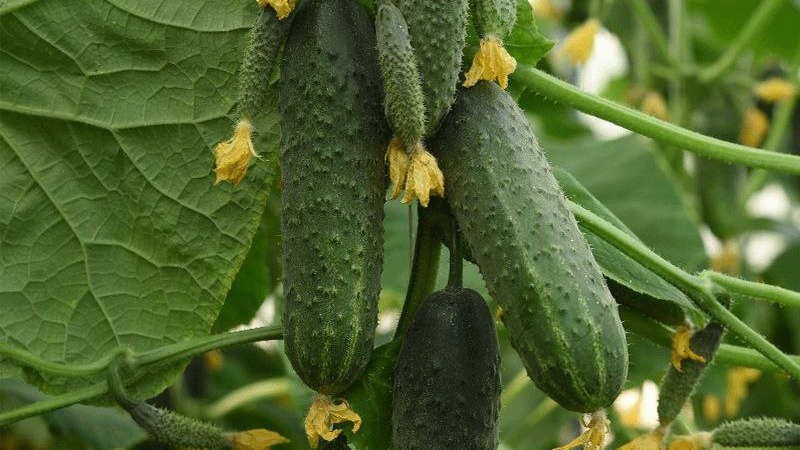
The Moscow Region has solidified its position as Russia’s second-largest producer of protected-ground vegetables, with a projected 2025 output of 131,000 tons. This figure is the result of a strategic, technology-driven expansion, representing a staggering 28-fold increase since 2014. The sector is anchored by modern complexes spanning over 228 hectares, with leading clusters in Kashira, Lukhovitsy, Elektrostal, Voskresensk, and Serpukhov.
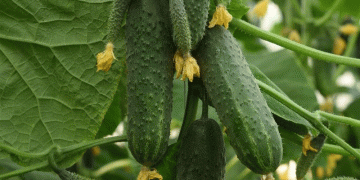
The production breakdown reveals a market-driven focus: cucumbers dominate with over 87,000 tons, followed by tomatoes at more than 37,000 tons, and green crops at 1,900 tons. Key players demonstrate the scale of modern operations: Agrokultura Group in Kashira has harvested over 61,000 tons, while Lukhovitskye Ovoschi exceeds 33,000 tons. Beyond scale, the region’s strategy emphasizes integrated logistics and digital transformation. Companies with their own distribution infrastructure ensure stable supply to retail chains, and digital tools are delivering measurable gains. For instance, the implementation of the “EcoVision” digital platform at the Podmoskovye greenhouse in Voskresensk reportedly halved crop losses and boosted yield by 30 tons per hectare per year.
This growth trajectory is set to continue with significant future investments. In Elektrostal, the Ivanisovo agri-complex plans a second-phase expansion of 15 hectares, involving 9 billion rubles in investment and creating 250 new jobs. More strategically, 2026 will see the launch of a landmark project in Voskresensk: the first industrial-scale tomato seed breeding and production center by APH ECO-cultura. With a planned capacity of 110-120 million seeds annually, the center aims to replace up to 50% of imported tomato seeds, addressing a critical vulnerability. This aligns with a global and Russian trend toward import substitution in agri-inputs, as noted in the FAO’s 2023 report on seed security, which emphasizes the strategic importance of domestic breeding programs for resilience.
The Moscow Region’s greenhouse sector is a compelling case study in modern agricultural development. It demonstrates that success is built on a multi-faceted approach: significant capital investment in large-scale infrastructure, the integration of digital management systems for efficiency, and forward-looking vertical integration into the supply chain—now extending all the way to seed production. For industry professionals globally, it highlights that the next frontier of competitive advantage in controlled environment agriculture lies not just in growing more, but in controlling the core genetic and technological inputs to ensure sustainability, quality, and strategic independence.