
















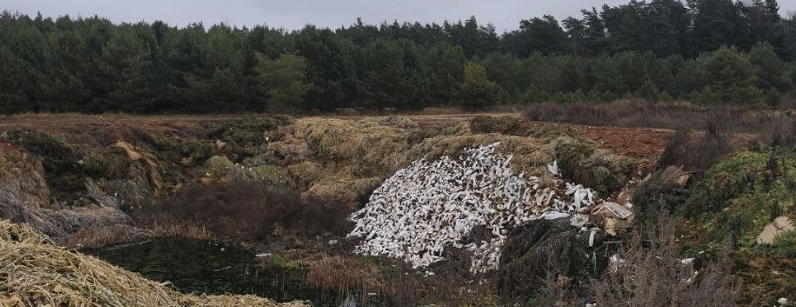
The recent enforcement action by the Ministry of Ecology of the Moscow Region in Serpukhov is a scenario no farm owner wants to face. As reported, inspectors confirmed illegal open-pit mining of common minerals (sand) on land owned by “Turovsky Greenhouse Complex” without a required license. Compounding the violation, the excavated pit was then used as an illegal dump site. This case, along with a similar one involving the agricultural enterprise “Zarechye-Oka” for illegal water withdrawal and dumping, highlights a critical and escalating issue: environmental compliance is a core component of modern farm management.
For farmers and agronomists focused on production, it’s easy to view unused plots or natural resources on a property as separate from core operations. However, regulatory bodies are increasingly using satellite monitoring, aerial surveys, and citizen reports to detect unauthorized activities. The financial risks are substantial. While the “Turovsky Greenhouse Complex” received an official warning, the next step is often severe financial penalties.
The High Cost of Non-Compliance: A Data-Driven Perspective
The practice of using agricultural land for unauthorized extraction or waste disposal is not isolated. It often stems from a view of these activities as secondary income streams or simple cost-saving measures for waste disposal. However, the data reveals a dangerous miscalculation:
- Skyrocketing Fines: In Russia, the fines for unauthorized use of subsoil (like sand mining) can run into millions of rubles. According to the Russian Code of Administrative Offences (Article 7.3), violations of subsurface resource use can lead to fines of up to 1 million rubles for legal entities, with confiscation of the illegally obtained resources and equipment. For illegal waste dumping, fines can be equally severe, with potential charges for land degradation.
- The Global Trend of Stricter Enforcement: A 2023 report by the UN Environment Programme (UNEP) emphasized a global shift towards strengthening environmental law enforcement. The report notes that countries are increasingly moving beyond voluntary compliance to “deterrence-based strategies,” including higher penalties and making remediation the financial responsibility of the polluter.
- The True Cost Includes Remediation: The greatest financial burden often isn’t the fine itself, but the legally mandated cost of land reclamation. A study on land degradation published in the Journal of Environmental Management highlighted that the cost of rehabilitating land after activities like unregulated excavation can exceed the short-term profit from that activity by a factor of 10 or more. The farm is left not only with a fine but with a permanent scar on its asset—the land—that it must pay to repair.
The cases in Serpukhov are a clear warning. For farm owners, agronomists, and agricultural engineers, proactive land stewardship is no longer optional. Every parcel of land, including unused plots and water bodies, must be accounted for and managed in compliance with environmental law. The potential short-term gain from illegal sand sales or cheap waste disposal is dwarfed by the long-term financial and operational devastation of fines, forced remediation, and reputational harm. Implementing rigorous internal controls, conducting regular land audits, and educating all employees on compliance protocols are essential investments to protect your business. Your land is your most valuable asset; protecting it means protecting your future.
