







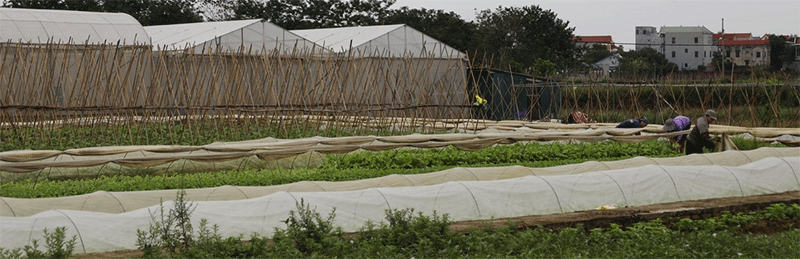
For decades, the farmers of Trung Gia Commune on the outskirts of Hanoi knew one brutal reality: hard work in the fields did not guarantee fair returns. They were prisoners of a volatile market, forced to accept whatever price visiting traders offered, often watching profits vanish. This cycle of “bountiful harvest, rock-bottom price” is a global agrarian distress signal, indicative of fragmented producers lacking market power and information. In Trung Gia, change began not with a top-down decree, but with the persistent vision of village chief Khong Minh Sang, who spent nearly 30 years witnessing this exploitation. His solution was radical yet simple: unite, standardize, and go organic.
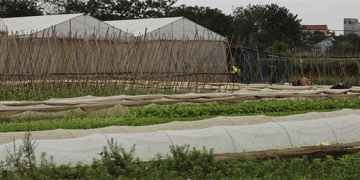
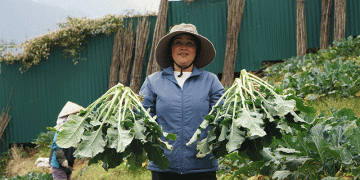
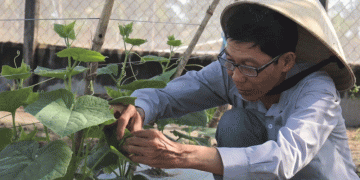
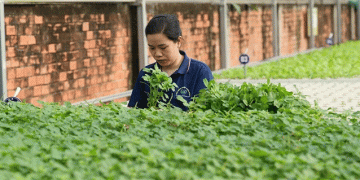
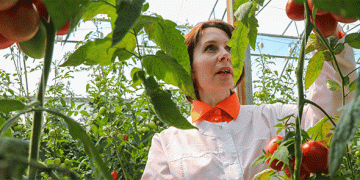
Sang’s vision crystallized into a concrete model with the establishment of the Trung Gia Agricultural Service and General Business Cooperative in 2020. The cooperative became the foundational “shield” for farmers, addressing the core vulnerabilities of smallholders. It provided the critical pillars for transition: 1) Technical Knowledge: Training in organic protocols, biological barriers, and crop rotation. 2) Standardized Processes: Enforcing uniform production logs and clean procedures. 3) Market Intelligence: Proactively sharing price and demand information, breaking the traders’ information monopoly. This holistic support helped establish two dedicated organic vegetable zones in Do and Thong Nhat villages, each over 3.5 hectares, producing mustard greens, Malabar spinach, kohlrabi, and tomatoes under strict standards for processors and safe-food chains.
The results are transformative. As Sang notes, “Before, people grew vegetables to sell mainly to traders. Now, there are people who come to buy organic agricultural products, so the price is much more stable.” This stability is the cornerstone of newfound resilience. The cooperative model has shifted the power dynamic, allowing farmers to plan production based on market signals rather than desperation. This aligns with broader trends in Southeast Asia, where FAO reports emphasize farmer cooperatives and contract farming as key tools for improving smallholder incomes and integrating into modern value chains. The cooperative is now planning an expansion to a 4.8-hectare new cultivation area, responding to market demand that still outpaces their current stable supply.
The Trung Gia model is a masterclass in sustainable agricultural development. It proves that technological adoption—often discussed in terms of sensors and automation—must be preceded by social and organizational innovation. The most powerful “digital tool” here was the cooperative structure that enabled the sharing of information. For farmers, agronomists, and policymakers worldwide, the key lessons are clear: Empowerment precedes efficiency. Building farmer collectives creates the scale and bargaining power necessary to invest in quality upgrades like organic certification. Information is a production input. Reliable market data is as crucial as good seeds. Leadership is local. Lasting change is driven by trusted community figures who understand both the soil and the soul of their neighbors. Trung Gia’s green fields now represent more than a crop; they symbolize a reclaimed future where farmers are no longer passive price-takers but active architects of their own prosperity.
