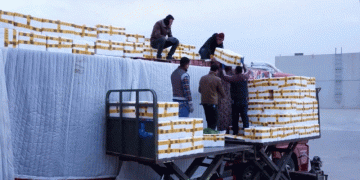




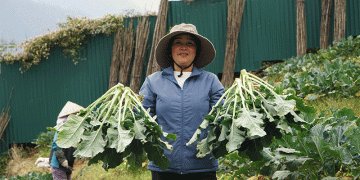
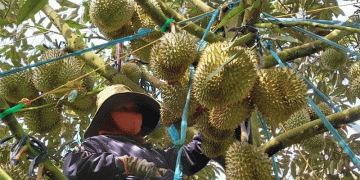
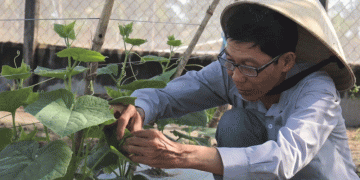





A seismic shift in fresh produce logistics is unfolding along the Silk Road. Driven by the Belt and Road Initiative, a seamless supply chain has been established from Kashgar in China’s Xinjiang region to markets across Central Asia. The key metric revolutionizing the trade: modern refrigerated trucks now complete the journey in a record 30 hours, a dramatic reduction that redefines the meaning of “fresh” for imported fruits and vegetables.
This is not merely a transportation upgrade but a fully integrated system linking production, export, storage, and distribution. Chinese agribusiness is actively embedding itself in the regional market. The wholesale Jiangnan Agricultural Market in Kashgar has already opened representative offices in Tashkent, Uzbekistan, and Dushanbe, Tajikistan, with plans to build its own warehouse complex in Uzbekistan. By November, this market alone had supplied 35,000 tonnes of produce worth over 200 million yuan to neighboring countries, demonstrating the corridor’s rapid scale.
The implications for local farmers, agronomists, and supply chain professionals in Central Asia are profound. This model sets a new standard for speed and integration, directly addressing the region’s growing demand for fresh produce, as highlighted in recent UNECE reports on Central Asian food security. However, it also introduces formidable competition. The efficiency of this corridor pressures local producers and existing import networks to modernize drastically. The focus on quality control and brand development, as stated by Jiangnan’s purchasing manager Zhang Dewei, indicates a move beyond commodity trading toward branded, trusted produce.
The 30-hour Kashgar corridor is a transformative development for Central Asian agriculture. It provides immediate access to a large volume of fresh produce, satisfying consumer demand. For regional stakeholders, it serves as a powerful case study in the critical importance of integrated cold chain logistics, strategic infrastructure investment, and market-led branding. The long-term question is whether this will spur a competitive modernization of local supply chains or lead to increased import dependency. The answer lies in how effectively regional producers, engineers, and policymakers can learn from and adapt this model to strengthen their own horticultural sectors.