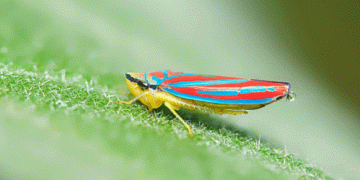







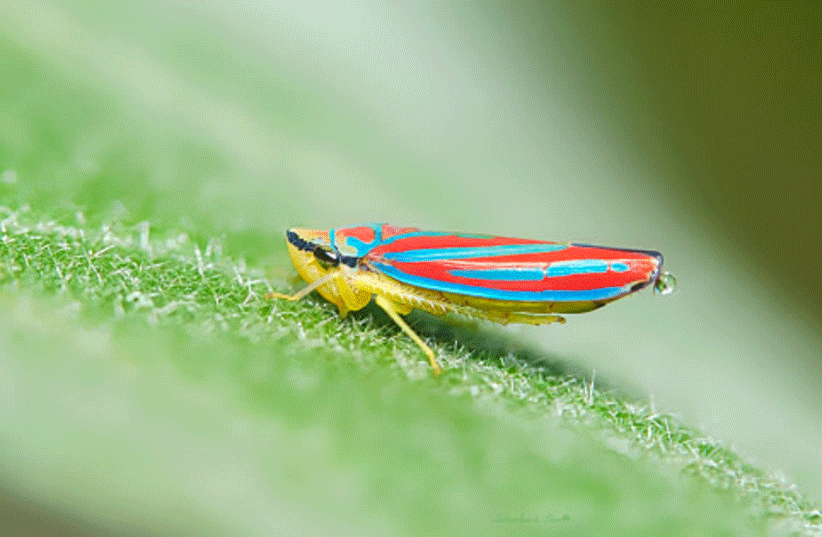
A groundbreaking study led by the Max Planck Institute for Chemical Ecology and the Fraunhofer Institute has uncovered the biological engine behind one of Europe’s most alarming recent agricultural invasions. The reed leafhopper (Pentastiridius leporinus), once a specialist feeder on reed grass, has rapidly evolved into a polyphagous pest attacking sugar beet, potato, carrot, and onion. The research, published last month, reveals that this transformation is driven not by the insect’s own evolution, but by the complex community of bacteria it hosts—a combination of nutritional symbionts and pathogenic agents.
The Bacterial Consortium: A Toolkit for Invasion
The insect is a flying reservoir for at least seven bacterial species, functioning as a sophisticated biological system. The study identified three core nutritional symbionts (genera Purcelliella, Vidania, and Sulcia) that produce essential amino acids and B vitamins. This internal microbiome allows the leafhopper to survive on nutrient-poor plant sap, effectively providing the metabolic passport to exploit a wider range of crops. Crucially, the insect also vectors two devastating plant pathogens: Candidatus Arsenophonus phytopathogenicus, which causes Syndrome Basses Richesses (SBR) in sugar beets, drastically reducing sugar content, and Candidatus Phytoplasma solani, the agent of stolbur disease, which leads to low yields across multiple crops.
Economic Impact and a New Control Paradigm
The economic implications are severe, particularly for the European sugar beet industry. SBR outbreaks directly attack crop value by diminishing extractable sugar, threatening a cornerstone of agri-processing. The traditional pest management paradigm is upended here, as the insect itself does negligible direct damage; the real threat is its microbial payload. In response, the research team is pioneering a novel control strategy. As Andreas Vilcinskas of Fraunhofer IME notes, they are “developing dsRNA-based sprays for the environmentally friendly and targeted control of reed leafhoppers.” This approach, based on RNA interference (RNAi), aims to silence critical genes in the pest specifically, offering a potential alternative to broad-spectrum insecticides.
A Microbe-Driven Threat Demands a Systems Approach
This research fundamentally changes how we view this emerging pest. The reed leafhopper is less a traditional insect pest and more a vector for a symbiotic-pathogenic bacterial complex that has collectively engineered a new ecological niche. For farmers and agronomists, this underscores the need for vigilant monitoring and diagnostics for the diseases (SBR, stolbur) as primary indicators. For scientists and agricultural engineers, it highlights that future pest management must increasingly target the biological alliances—like the insect’s nutritional symbionts—that enable pest success. For farm owners and policymakers, it reinforces the critical importance of funding research into next-generation, targeted biopesticides like RNAi sprays. The battle is no longer against an insect alone, but against the manipulative microbiome that empowers it.