











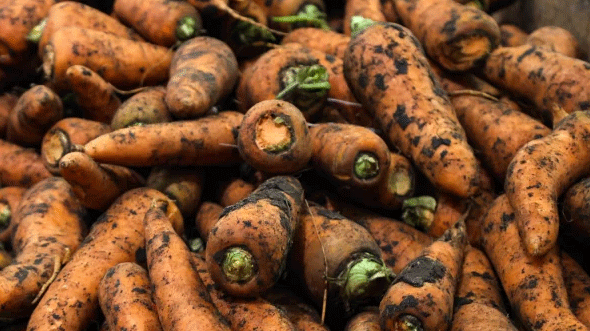
Authorities in Russia’s Kuzbass (Kemerovo) region have reported a significant breach of quarantine legislation, with 347 tons of fresh produce entering the region without mandatory phytosanitary certification during the week of November 24-28. The shipment consisted of 242 tons of fresh onions, 83 tons of watermelons, and 22 tons of carrots. According to the Siberian Interregional Directorate of Rosselkhoznadzor, the importers failed to notify the agency of the cargo’s arrival and did not present the goods for the legally required phytosanitary control, a direct violation of federal plant quarantine laws. As a result, the regulatory body issued four official warnings to the importers about the inadmissibility of such violations.
This is not a simple administrative oversight; it is a critical failure in the first line of defense for agricultural biosecurity and consumer safety. Phytosanitary certificates are essential documents that verify a shipment is free from regulated pests, diseases, and excessive pesticide residues. The Russian agricultural monitoring system, part of the broader Eurasian Economic Union (EAEU) framework, is designed to intercept threats like the Colorado potato beetle, various fruit flies, or bacterial rots that could devastate local crops. According to a 2023 global food safety report by the World Health Organization (WHO) and FAO, unregulated food channels are a primary vector for foodborne illnesses and the introduction of agricultural pests, contributing to an estimated 600 million cases of foodborne disease annually worldwide. The scale of this unreported shipment—particularly the high-volume onion and watermelon consignments—poses a dual risk: unknown phytosanitary status for local farms and potential health hazards for consumers, as the produce’s chemical treatment history is unverified.
The case of the 347 uncertified tons in Kuzbass is a stark alarm bell for the entire agri-food system. It demonstrates that robust regulations are only as strong as their enforcement and the compliance of supply chain actors. For farmers, this represents a direct threat from potentially infested or diseased produce that could compromise local crops. For agronomists and engineers, it underscores the need for more traceable, “farm-to-fork” digital systems that make such large-scale bypassing of controls more difficult. While warnings were issued, the incident highlights a potentially systemic vulnerability where economic incentive can override regulatory obligation. Ensuring food safety and protecting domestic agriculture require not just stringent laws but also vigilant monitoring, severe penalties for non-compliance, and technology-driven transparency that leaves no blind spots for unauthorized produce to enter the food chain.
