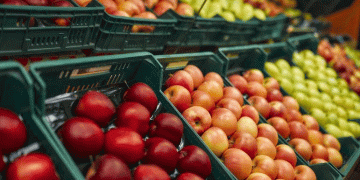




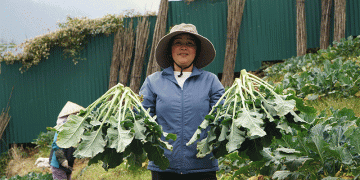
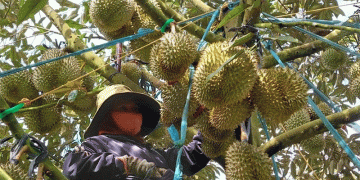
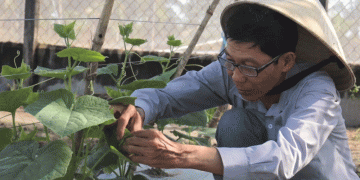







A new report from the UK advocacy group Sustain, titled “Bridging the Gap,” presents a powerful economic and social case for government support of organic and sustainably grown fruit and vegetables. The analysis, based on nine pilot programs across the UK, found that connecting produce from small and medium-sized farms to low-income households generated a staggering £8.78 in social value for every £1 of public investment, with an additional £1.10 contributed by the shoppers themselves. This model directly challenges the perception of organic food as an unaffordable luxury and positions it as a catalyst for systemic change.
The pilots achieved this by strategically using public investment to close the price gap for consumers, creating steady demand through institutional procurement (like school meals), voucher schemes, and partnerships with retailers like the mobile greengrocer “Queen of Greens.” In Liverpool and Knowsley, this approach now provides 700 people per week with access to organic produce they previously could not afford. The generated value was quantified across four key areas: £3.11 in health benefits, £3.94 in stronger communities, £1.44 in local economic growth, and 29p in climate and nature benefits. This aligns with broader research; a 2023 study in The Lancet Planetary Health concluded that fiscal policies to increase fruit and vegetable consumption are among the most cost-effective measures for improving population health and reducing healthcare burdens.
The report arrives at a critical political juncture, with the new Labour government having pledged that 50% of publicly procured food will be local or meet higher environmental standards. Sustain argues it is time to honour this pledge through three priority actions: boosting British production, investing in local food infrastructure (like processing and distribution hubs), and improving access to healthier foods for all. This approach creates a virtuous cycle: steady public-sector demand de-risks investment for farmers, fair prices improve farm viability, money circulates locally, and community health improves.
The “Bridging the Gap” report provides a compelling, data-driven blueprint for transforming food systems. It moves the debate beyond ideological arguments about organic farming and frames it in the hard-nosed language of investment returns, risk reduction, and public health cost savings. For farmers and agronomists, it highlights a viable pathway to fair prices and stable demand through differentiated, quality produce. For policymakers and agricultural engineers, it underscores the necessity of investing in the “middle infrastructure” that connects farms to communities. The ultimate finding is that supporting localized, ecological agriculture is not a niche or costly ideal, but a strategic investment that pays manifold dividends in community resilience, economic vitality, and national well-being.
